
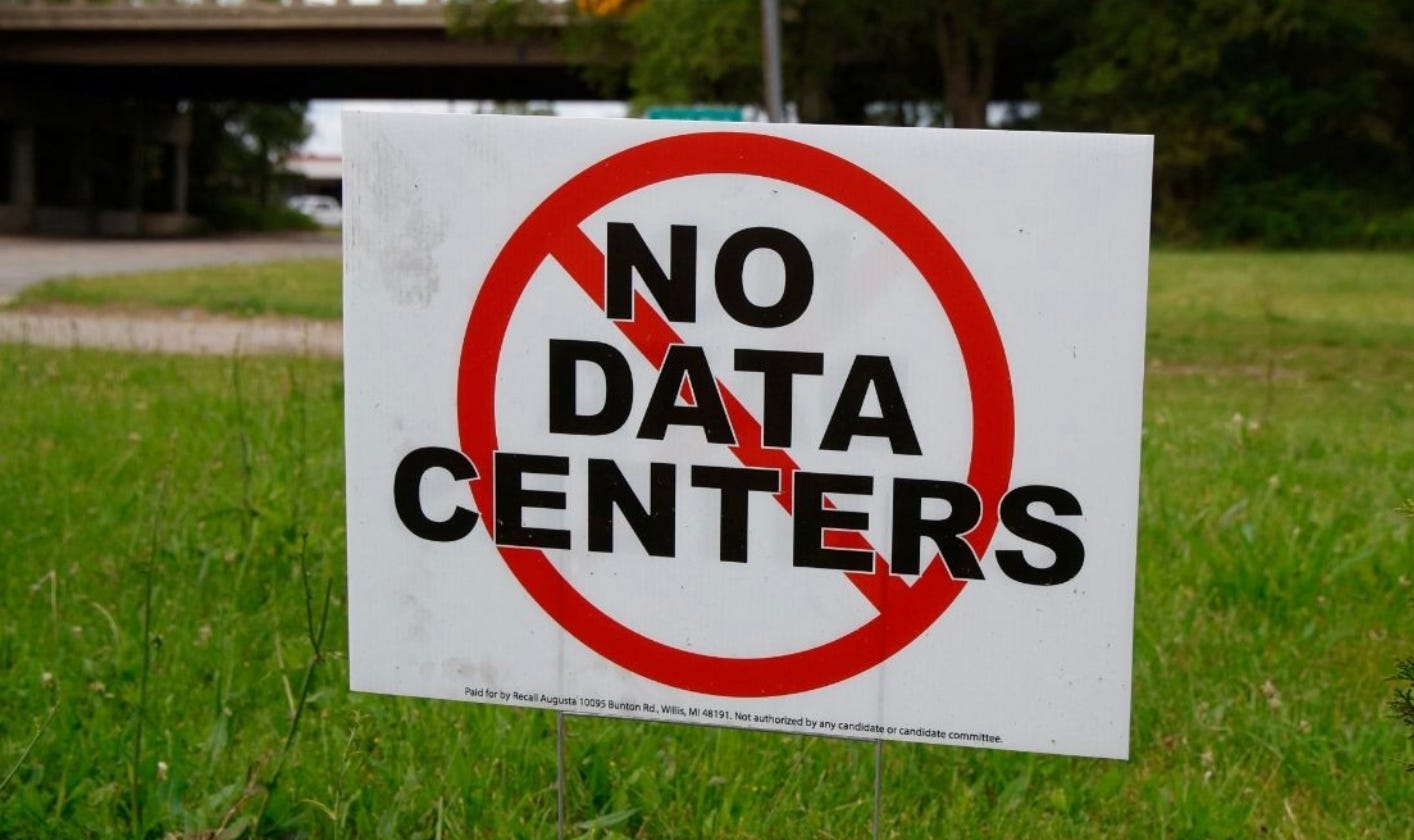
Give Virginia State Senator Louise Lucas credit: she knows a good political issue when she sees one. While her recent efforts to hold Virginia’s two-year budget hostage over tax subsidies for data centers gave many pause, it certainly focused attention on what has emerged as a major national issue. And it helped turn data centers from a wonky economic-development discussion into a potent political one.
Make no mistake: data centers are essential to cloud computing and for America to maintain its edge in AI development. They provide substantial economic benefits, including significant tax revenues for localities. [1] And research suggests that, with proper regulation, their impact on water and air quality can be mitigated.[2]
All of this may be true.
But the politics have changed!
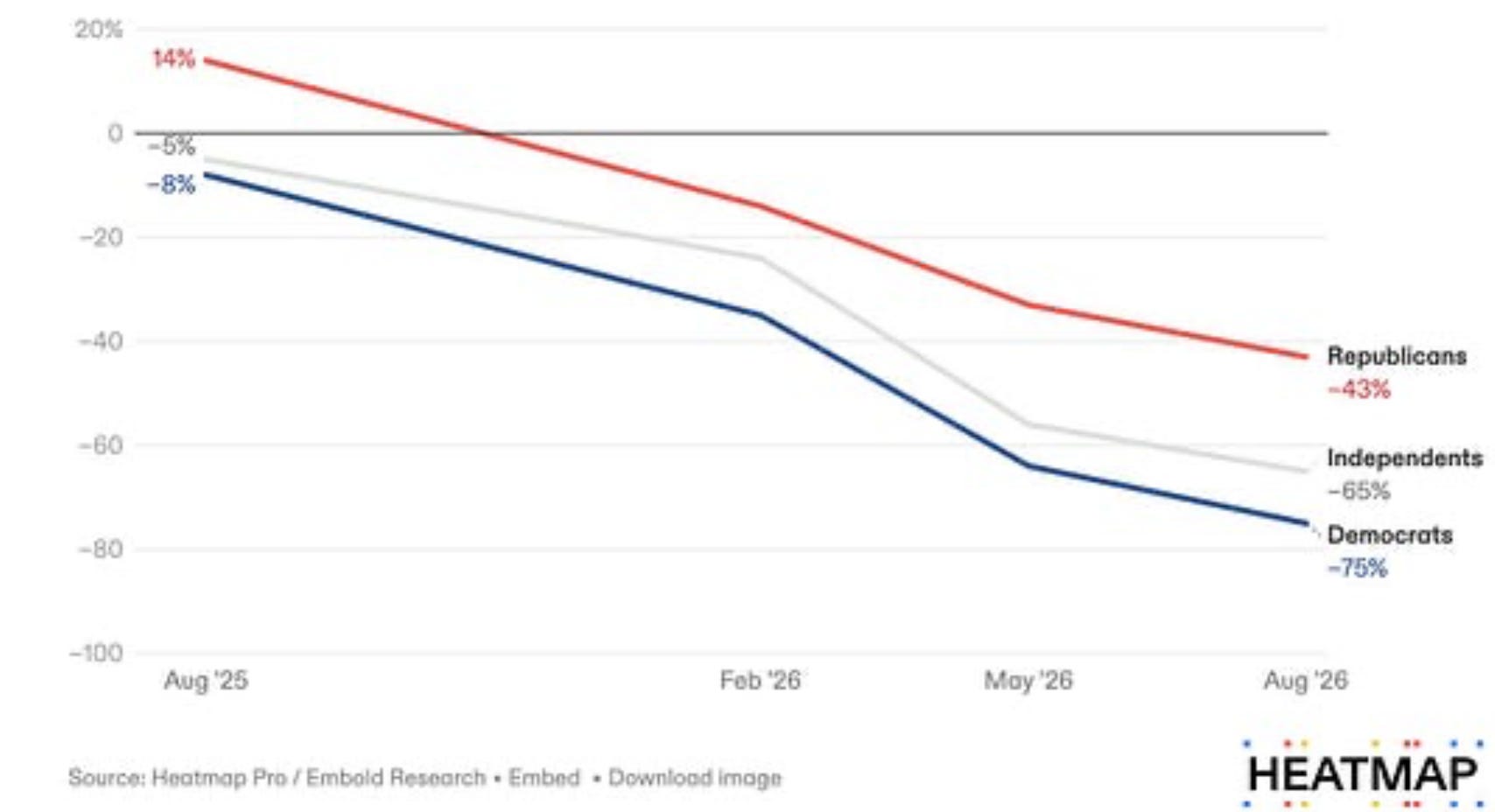
Americans are increasing skeptical of these energy-consuming behemoths. A national Gallup poll found that 71 percent oppose having a data center built in their community. Similar results were reported by the University of Pennsylvania’s Annenberg Policy Center, whose July survey showed a 12-point jump in opposition in only four months.
This Heatmap graph shows the collapse in the last year.
Even in Virginia and Texas, the states with the highest number of centers, public opinion has turned against the industry. 72% of registered Virginia voters oppose sales tax exemptions for centers, and 81% believe they should pay extra fees to offset the heavy electricity demands they place on the state’s energy grid. A recent poll in Texans found that almost 60 percent oppose the construction of data centers in their community, including two-thirds of those living in rural areas, where the industry hopes to spread.
These numbers should set off alarm bells with politicians.
In many places, it is becoming political malpractice for an elected official to defend data centers. And your political party makes no difference.
Republicans may face the greatest difficulty navigating the politics. President Trump is closely associated with the industry, recently calling data centers “a tremendous thing”, criticizing Democratic New York Gov. Kathy Hochul for pausing their construction, and then scolding Republican Texas Gov. Greg Abbott for doing the same.
But voters do not appear particularly interested in party talking points. They are worried about who pays the bill.
The Terrain
At least 4,000 data centers are spread across the country, with the largest concentration in Virginia, Texas and California. Demand for data centers is projected to grow 9% annually through 2030.
Thirty-eight (38) states offer dedicated tax incentives for data centers, ranging from sales and use tax exemptions for computers and electricity to property tax abatements. And state subsidies to the industry are enormous; Virginia’s now total $1.9 billion per year, a hefty chunk out of the state’s budget.
The issue is further complicated by the fact that local governments receive huge tax benefits from the centers. In Henrico County, Virginia, taxes generated from data centers help create a housing trust. Loudoun County will receive nearly $1.3 billion in local tax revenues from its centers in FY27; in the last decade, officials reduced real estate tax rates because of data center tax revenue.
More than Congress is Up for Grabs
Americans are rightly focused on this year’s Congressional elections. But these seats are not the only races this fall --36 states have governor contests, and 6,122 legislative seats in 46 states at up for grabs. And recent elections show that the data center debate can affect results. In Georgia, one of the fastest growing data center states, two Democrats recently won major upsets in races for the Georgia Public Service Commission by criticizing the state’s tax incentives for the industry and arguing that ratepayers should not be made to subsidize data center electricity demands. This marks the first time in two decades that Democrats have won any seats on the body.
In the recent Democratic governor’s primary in Kansas, state Senator Laura Holscher upset a better funded candidate endorsed by two-term governor Laura Kelly, largely because she opposed public subsidies for data centers and sports stadiums (the state just enacted a 20-year tax subsidy). In Michigan, William Lawrence, an insurgent candidate who strongly criticized data centers, won his primary contest against several traditional candidates. And Utah Senate President J. Stuart Adams’ strong support of a controversial data center is widely believed to have caused his recent primary loss.
Local elections have also been affected. In June, two county commissioners were ousted in Spartanburg, S.C, after supporting a large center opposed by their constituents. Local officials in Frederick and Calvert counties, Maryland lost seats to data center opponents. Four incumbents in this spring’s city council election in Festus, Missouri were defeated after supporting a new center. The Louisville, Kentucky suburbs witnessed a similar dynamic, as several incumbents supporting the industry were ousted in primaries.
Actions in the States
Some elected officials are responding quickly to the increasing opposition.
New York Gov. Kathy Hochul(D), known for her support of the tech industry, made New York the first state to halt construction of new data centers when she signed an executive order this July. In Illinois, Gov. JB Pritzker(D) paused tax incentives. Washington legislators removed a tax exemption for data center replacement equipment. Pennsylvania Gov. Shapiro(D) just imposed stricter requirements on the industry, Nebraska Gov. Jim Pillen recently paused tax incentives for the industry. and New Hampshire Governor Ayotte (R) has recently announced her support for a moratorium.
Like Senator Lucas and her colleagues in Virginia, Arizona Governor Katie Hobbs(D) attempted to use the state’s budget process in hopes of repealing data center tax incentives, which cost the state $38 million, a pittance compared to Virginia or Texas. She did not win her fight with the Republican legislature, but a compromise emerged by which the state budget imposed a three-year moratorium on the tax breaks.
Legislators in fifteen states recently introduced bills to ban or delay new data centers. None became law. Maine came the closest; the legislature passed a temporary ban, but the bill was ultimately vetoed by outgoing Gov. Janet Mills.
Rural and suburban localities across the country are passing data center prohibitions, including, in Virginia, where Spotsylvania County Supervisors just called for a statewide moratorium, and ordinances are being considered in Warren, Henrico, Frederick, and even Loudoun, arguably the data center capital of the world. Fredericksburg and Chesterfield just rejected centers proposed for their communities.
This is not a NIMBY problem; it is a bipartisan, cross-geographic revolt.
This Fall’s Elections
Data centers have emerged as major issues in the Georgia and Texas governor’s races. In Georgia, the state with the nation’s fifth-largest concentration of data centers, Democratic gubernatorial candidate Keisha Lance Bottoms is calling for a temporary pause on new construction and criticizes her opponent for investing in a Texas data center and touting the industry’s economic benefits. Gina Hinojasa, the Democratic candidate opposing Greg Abbott, one the industry’s strongest supporters, in Texas, has made opposition to data centers a central campaign issue.
And the issue could impact who controls the U.S. Senate. In Ohio, where 71 percent of voters favor a moratorium on new construction, tax subsidies for the centers cost the state nearly $1.6 billion in 2025—vastly more than earlier estimates. Democrat Sherrod Brown is using this a wedge to flip a critical seat, slamming the incumbent’s record of supporting tax breaks for data-center developers while serving as the state’s attorney general.
As Virginia Goes….?
Of all the states, Virginia is the most intriguing. The Commonwealth has the largest concentration of data centers in the country and some of the industry’s most generous tax incentives. But, unlike many states, neither the governor nor the legislature is on the ballot this fall.
That gives Virginia leaders something rare: time to make policy without the pressure of an immediate election.
When the General Assembly first exempted data centers from the retail sales and use tax on computer equipment in 2008, there was little opposition. The estimated revenue loss to the Commonwealth was just $2.46 million for fiscal years 2009 and 2010.
Two years later, lawmakers expanded the exemption to include centers employing fewer workers in distressed areas. In 2016, with little opposition again, they extended the exemption sunset date from 2020 to 2035. At that time, 13 data center operators were taking advantage of the subsidy, which cost the Commonwealth $49 million in Fiscal Year 2015.
A decade changed everything.
The subsidies worked, and Virginia today is home to over 600 centers--the largest concentration in the world. Their tax subsidies have now grown to an estimated $1.9 billion per year, and the 82% of the benefits flow to just five companies. Most observers agree that the centers place enormous pressure on the electric grid and their demand for electricity is pushing up prices.
Gov. Abigail Spanberger is trying to walk a difficult line between supporting the technology industry and responding to the growing public backlash. She has yet to support a building moratorium, an attractive political option which does little to affect the massive subsidies nor our future needs
Instead, the governor insists that centers “pay their own way”. She signed an executive order requiring the centers to pay the full cost of new transmission infrastructure built exclusively for them, and the State Corporation Commission (SCC) supported the action by ordering major utilities to shift 100% of those costs onto the high-consuming facilities. And she signed a budget that imposes a temporary electricity-consumption tax that could raise $600 million and provides some hope that consumers could receive some electricity rebates to help with their bills.
Under the budget compromise, legislators and the governor are required to consider other reforms, and the subsidies—which are set to expire in 2035-- are likely to be part of that. Expect efforts to condition future tax breaks to the protection of water supplies and commitments to use on-site solar and battery as backup power in lieu of gas-fired generators.
Other states are watching because of the state’s importance to the industry.[3] If Virginia can develop a framework that allows data centers to grow without shifting their costs onto taxpayers, ratepayers and communities, other states are likely to follow.
A resolution will involve neither unlimited subsidies nor a moratorium, but a regulatory framework in which the industry pays its full costs and addresses the energy and environmental challenges. The Commonwealth was a leader in helping establish the industry; we will now see how it will shape its future.
ANOTHER STUNNING UPSET IN A SPECIAL ELECTION. On Tuesday, August 18, Democrat Brandon Dukes flipped a conservative state House district north of Pittsburgh.
The seat was held by Republicans for nearly 30 years.
The victory increases the Democratic state House majority to 103-100. Dukes will try to keep the seat in the upcoming November election.
This is not the only major flip of a state legislative seat in Pennsylvania since Trump took office. In March 2025, James Malone won a state Senate seat in Lancaster County in a district won by Trump by 15-points.
It was also the 31st legislative flip of the cycle, all of them won by Democrats.
[1] In Virginia, for example, one report argued that data centers generated nearly $40 billion in statewide economic impact in 2025, and that the sector supported more than 112,000 jobs, provided roughly $9 billion in employee compensation, and contributed over $1.5 billion in state taxes alongside $1.3 billion in local property taxes. That they contribute huge tax dollars to localities seems not to mollify the opponents.
[2] https://fieldreport.caes.uga.edu/publications/TP121/how-data-centers-impact-surface-and-ground-waters/.
[3] NC Clean Energy Technology Center (NCCETC) operates the Database of Emerging Large-Load Tariffs — the first public, user-friendly database of contemporary utility tariffs and service rules for large loads. The site includes much information about state policy and regulatory trends. UVA has a similar database.
A condensed version of this appeared in the Richmond Times Dispatch.
Thank you for the clearest description of Data Centers that I have encountered anywhere
Well said!
As someone who worked in the energy industry for 50 years, there’s a fundamental disconnect driving the data center problem. Which is that most people think data is ‘free.’ We don’t get charges for our searches or our apps.
But data centers are now beginning to show us the cost of data, especially as AI models blow up computing demand, and energy demand, to unheard of levels. For much of the 20th century, there was a similar view of electricity. As power grids were built, engineering drove economies of scale, and rates kept falling. Nuclear power was going to be ‘too cheap to meter’ in the 1950s.
That all changed in the 1970s, when grid economies topped out, fuel prices spiked, and we began to account for the environmental impacts. Power prices rose; markets and policies drove energy use efficiencies, so that by this century we had flattened electricity demand growth, even as the economy grew.
We are now, or should be, at a similar juncture with data centers. They are not free—they come with steep energy and environmental costs. But the basic business model for data is flawed—users pay almost nothing, though we agree to donate our data and our attention. Imj, until we price data services honestly, so that they reflect their true costs, I don’t see a way to keep data centers from overwhelming our grids, our water supplies, and our land.