Higher Education Under Attack:
Federal Firestorms and Statehouse Power Plays

The battle for the future of U.S. higher education is on. President Donald Trump frequently asserts that “our colleges [are] dominated by Marxist Maniacs and lunatics.” Vice President Vance argues that conservatives should “aggressively attack the universities in this country.” The Heritage Foundation proclaimed that “too many schools have lost their way” and proposed, in Project 2025, that the Justice Department’s Civil Rights Division serve as the “vanguard” in investigating and prosecuting institutions of higher education over diversity, equity, and inclusion (DEI) initiatives. They have made their intentions clear--to change the country, transform higher education.
2025 brought a new level of attack. Almost every institution--public and private-- felt the heat. Trump suspended grant funding to force universities to adopt policies to his liking. The administration made it increasingly difficult for international students to enroll and continue their studies in this country, undermining a major source of revenue for our universities and an important source of research talent.[1] And DOJ has embraced the challenge of Project 2025; it is now leading these attacks. In this year, 120 investigations have been opened at 60 institutions in over 40 states. University leaders anxiously wonder whether their school will be next to receive a letter from DOJ announcing an investigation.
Never underestimate the turmoil caused by DOJ targeting. Simply look at the University of Virginia, where DOJ was able to use threats, a compliant state government, and a cowardly governing board to force the resignation of a popular and effective President. You can read more here and here, including my op-ed in the Richmond Times Dispatch about how our new governor, Abigail Spanberger, should respond. While most of Trump’s fury and federal intervention has been directed at the “elite privates” like Harvard, Yale, and Columbia, state institutions like UVA and UCLA are increasingly being targeted, not only by DOJ but by conservative governors and state legislatures.
States Are the Laboratories
While federal actions attract headlines, changes at the state level may prove more consequential over the long term. State colleges and universities educate the largest share of American students and generate the bulk of undergraduate degrees. Today, we see many examples where governors with national ambitions join with conservative state legislatures to promote their agenda.
Florida is the textbook case. The state passed the “Stop WOKE Act” in 2022, a measure to prohibit DEI programs in colleges and universities. In 2023, Gov. Ron Desantis’s appointments to the governing board of the New College of Florida led to sweeping changes at the school. In January 2025, the Florida Board of Governors overhauled curricula across the state’s public institutions, removing courses that explored issues of race and gender. These measures have been described as among the most sweeping state attempts to regulate college curricula in recent memory. But the changes have not helped the institutions; more than two years after the conservative takeover of New College of Florida, its rankings have plummeted and costs have exploded.
Other states — including Texas, Indiana, Ohio, Alabama, Utah, and Iowa — have adopted laws and board policies to curtail diversity programs and place new limits on professors. In May, the University of North Carolina System’s board of governors forced the elimination of DEI programs and positions at 17 campuses.
Conservatives have also engineered leadership changes. The President of Texas A&M was fired after a controversy involving the release of a secretly-made video showing a classroom dispute between a student and an instructor about the appropriateness of exploring issues of gender identity. Northwestern’s President resigned several months after conservative state lawmakers opened an investigation into the school’s handling of pro-Palestinian protests on its campus.
Not every state has taken this path. Those with Democratic leadership — such as California, Illinois, and New York — have resisted federal pressure to curtail academic freedom and unwind their efforts for DEI.
Is Public Support for Higher Education Slipping? It’s Complicated.
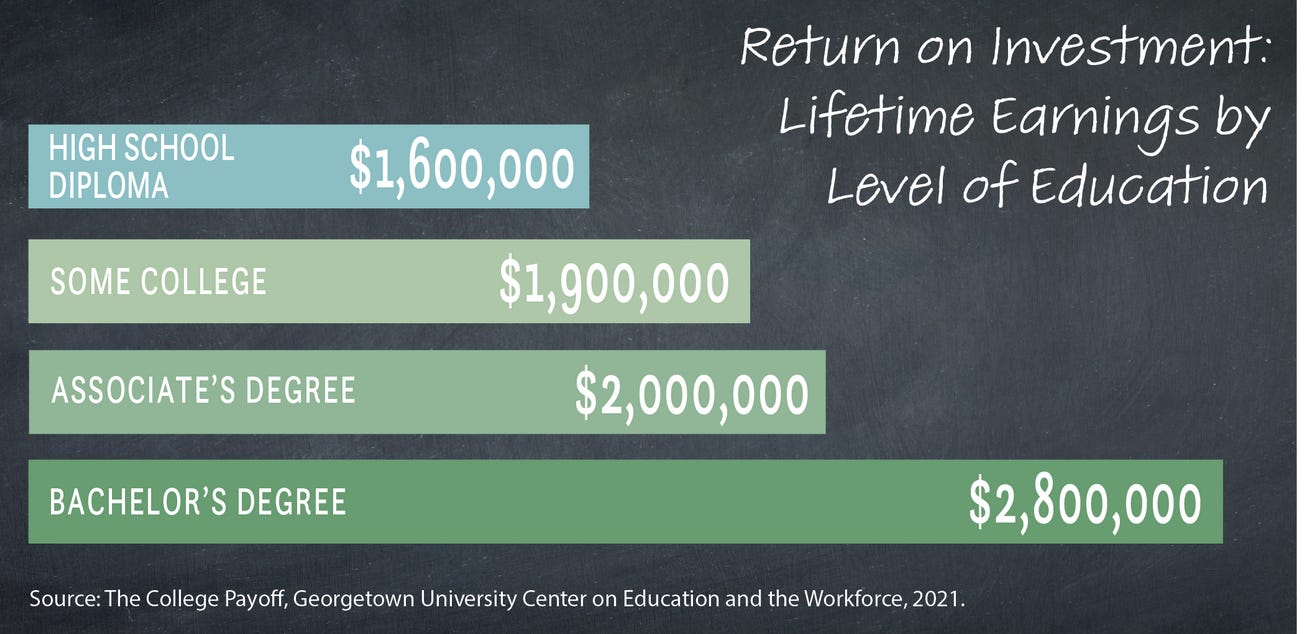
Americans’ views on higher education are complex and evolving. For the last century, Americans viewed the U.S. system of higher education as the envy of the world, and a source of economic growth and technological innovation. A college education was the way to “get ahead”, studies consistently showing that college graduates do better economically than those with a high school degree.
Recent polls, however, show overall public confidence in higher education has declined in the last decade, reaching multi-year lows in recent years. Gallup polling reported that in 2015, nearly 60% of Americans surveyed expressed strong confidence in colleges; by 2024, this had fallen substantially. Similarly, a October 2025 survey by the Pew Research Center reported that seven in ten Americans say the U.S. higher education system is headed in the wrong direction.
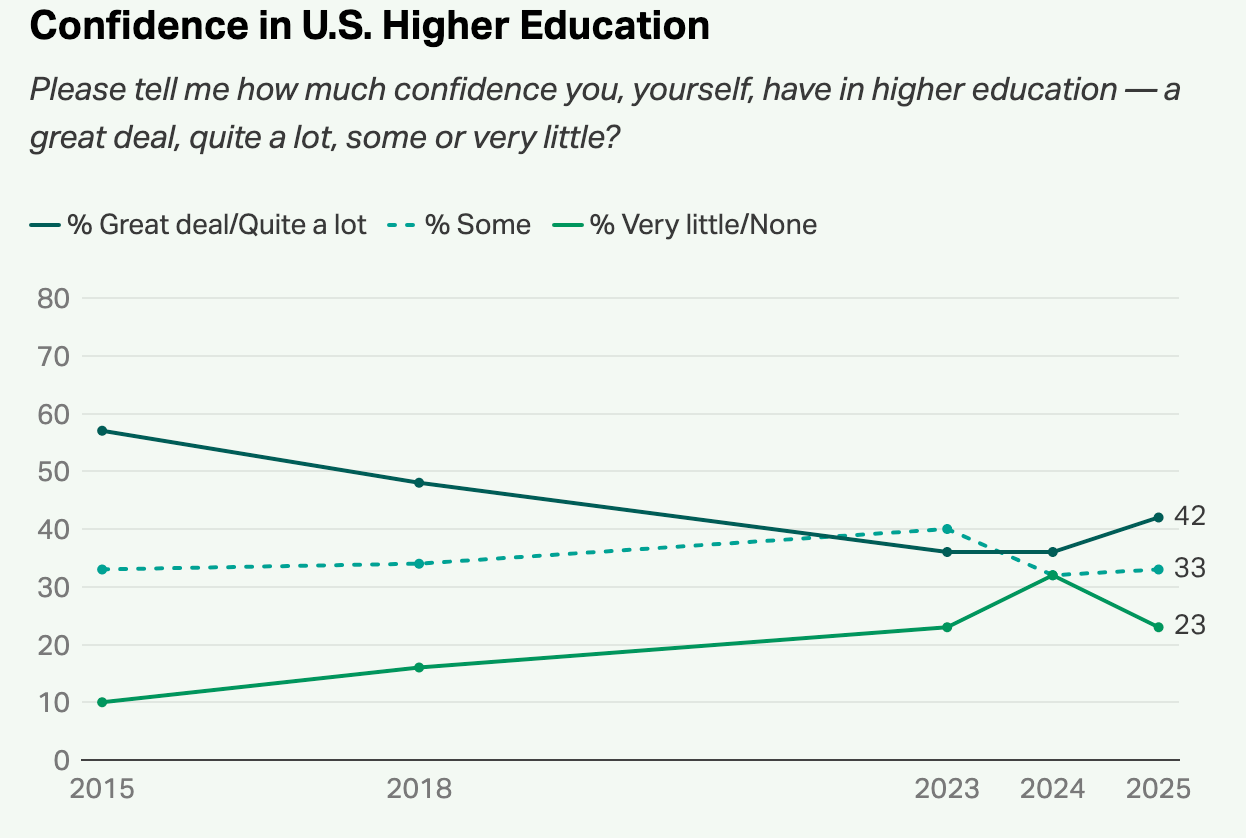
In mid-2025, Gallup reported the first noticeable uptick after a decade of decline, finding that 42% of Americans now say they have “a great deal” or “quite a lot” of confidence in higher education, up from around 36% in previous years, but the general trend has been downward. Democrats are significantly more likely to express confidence than Republicans.
The constant refrain of the conservative spin machine that higher education is nothing more than liberal indoctrination explains some of these numbers, especially among Republicans, many of whom were counted as strong advocates for these institutions only a decade ago. But criticism of higher education is not limited to perceptions of political bias.
Tuition and costs continue to rise at many institutions, and the public struggles to understand why more schools invest in elaborate facilities that seemingly have little to do with education. Citizens also do not understand—nor do many universities adequately explain---why the overhead costs of research are so high. Increasing layers of bureaucracy and the hiring of non-academic staff are questioned. Finally, there is growing concern that academic standards are not sufficient to prepare students for what is needed to be successful in a challenging economy.
Reasons for Optimism
Despite this swirl of negativity, some studies provide reason for optimism. Large majorities of Americans oppose cutting federal or state funding for science, health, or education by margins of roughly four or five to one. Nearly half of Americans say they favor more investment in scientific research, and 57 percent want more medical research funding.
And surveys show that Americans have more confidence in public colleges and universities than in private ones. In a 2025 survey, nearly half of respondents (46 percent) reported “a great deal” or “quite a lot” of confidence in public institutions, while only 30 percent felt the same about their private counterparts. Among traditional Republicans, the gap between assessments of private and public universities is even larger. For example, over 40 percent of traditional Republicans have confidence in public universities, but that number drops to just 16 percent for private institutions.
These data are significant, if only because public institutions award between 60 and 70 percent of undergraduate degrees. In Virginia, the number is approximately 67%.
State-specific surveys often reveal higher levels of trust in state universities than found in national polls. A recent poll in Virginia found confidence rates substantially above national figures. Only 18% expressed “very little” confidence in our colleges and universities, well below the 32% nationally. And the gaps between Republicans and Democrats are also smaller in Virginia. This is one reason why the twenty-two appointments that new Governor Spanberger will make to various Virginia college boards when she takes office this month are so critical; she can calm the rhetoric and set an example for the next four years.
Key Role of State Governing Boards
State colleges and universities are typically overseen by Boards of Trustees or, in the case of Virginia, Boards of Visitors. Historically, these boards largely deferred to academic leadership and focused on institutional goals rather than politics. Today, however, as appointments have become increasingly political, some board members are taking a more aggressive posture.
In 42 states, board members are appointed by the governor, and most are then subject to final approval by state legislatures.[2] Historically, legislatures have let governors have their choices. But as partisanship has intensified, appointments have become increasingly contested, especially in states where governors and the legislature are from different parties. In Wisconsin, for example, Democratic Gov. Tony Evers was unable to stop the Republican legislature from removing board members he supported, an action rarely seen in the recent past. And in Virginia, the Democratic Senate stopped approving Gov. Youngkin’s nominees once it was clear that he was pursuing an agenda not shared by the legislature.
In sharp contrast to previous governors, Youngkin argued that board members owed their primary duty to the state and not the institution. Many appointees embraced the governor’s attack on everything “DEI.” In May 2024, despite several years of work, plans by George Mason University and Virginia Commonwealth University to incorporate race- and diversity-related subjects into the general education curricula were blocked by boards whose majorities had been appointed by Youngkin. In early 2025, VMI’s Board voted against renewing the contract of the school’s first Black superintendent, Major General Cedric T. Wins, after he led efforts to expand diversity at the institution. Concerns arose about plans to replace the African American President of George Mason University for his DEI support. The UVAs Board involvement in Jim Ryan’s forced resignation may have received the most publicity, but it is only part of a national pattern of Boards pushing a political agenda.
Headlines Focus on Washington — But the Real Action Is in the States
Will 2025 be remembered as a turning point for American higher education, as institutions capitulate to federal and state pressures aimed at reshaping their governance and curricula? Or will educators, policymakers, and business leaders succeed in reaffirming higher education’s traditional role as a source of innovation and democratic vitality?
One constant stands out: while federal interventions draw most headlines, many of the most consequential decisions will be made at the state level. The actions of governors, legislatures, and governing boards will be critical in determining the future of U.S. higher education.
[1] According to the Association of International Educators (NAFSA), a drop in fall 2025 international student enrollment generated a revenue loss of $1.1 billion to the institutions and cost nearly 23,000 Jobs. Virginia alone received $893.5 million in the 2024-25 academic year from more than 23,000 international students at its colleges and universities.
[2] In eight states, the Governor plays no role in the appointment process. Minnesota, North Carolina, South Carolina, Pennsylvania, and Vermont have boards directly appointed by the legislature or already-seated board members. In Colorado, Nebraska, Nevada, and Michigan, some or all board members are chosen in statewide elections.