The Tab Comes Due:
Illegal Tariffs Cost Virginia Families $6 Billion

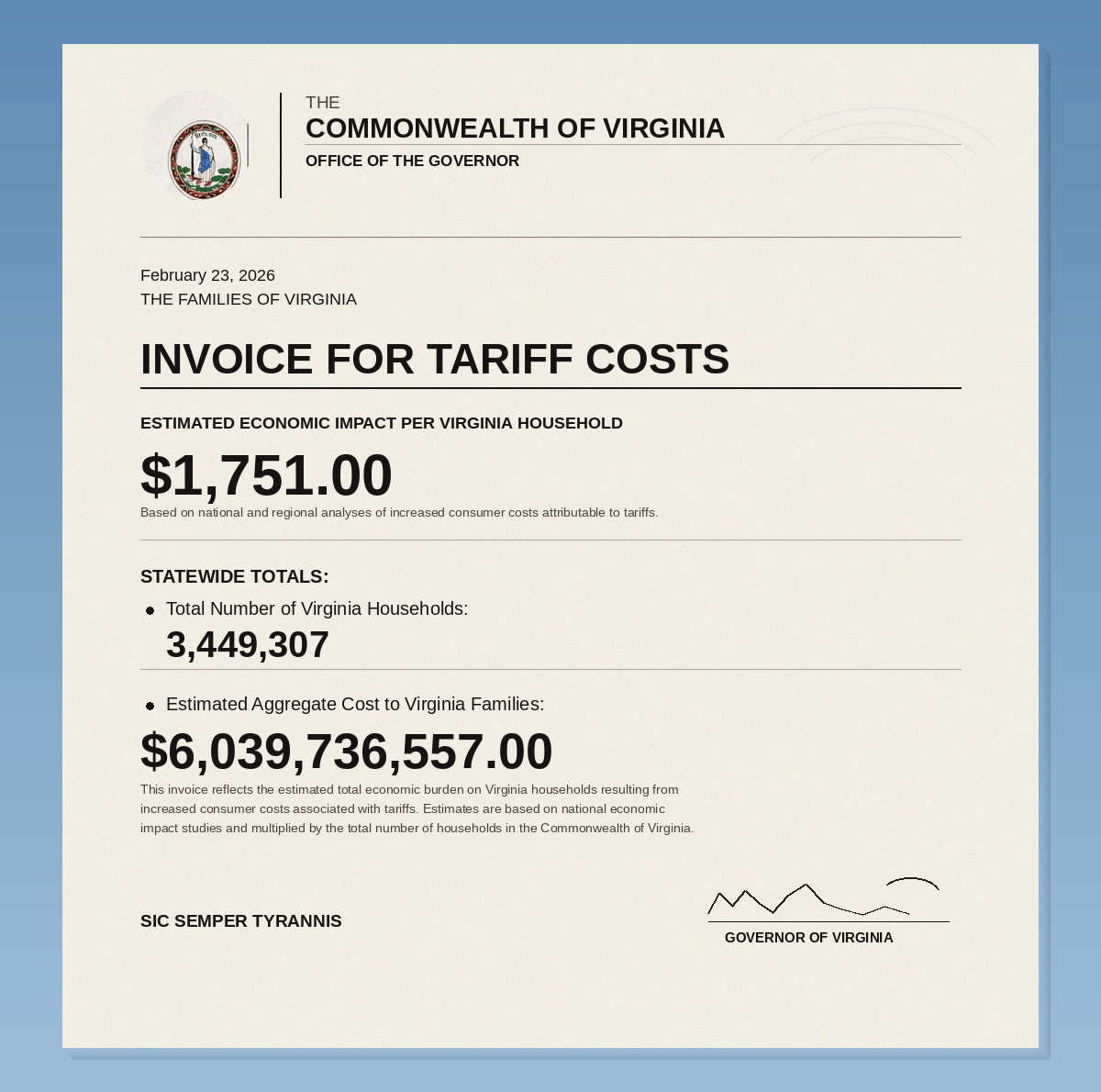
On February 20, 2026, the U.S. Supreme Court ruled that tariffs imposed by President Donald Trump under the International Emergency Economic Powers Act (IEEPA) were unlawful. With that decision, billions of dollars collected from Americans through higher prices were deemed to have been illegally extracted.
Shortly after the ruling, Illinois Governor J.B. Pritzker submitted an invoice to the federal government itemizing the financial harm suffered by households in his state because of the tariffs. The invoice served an important purpose: it translated an abstract trade policy into a concrete household expense. During her response to last night’s State of the Union, Virginia Governor Abigail Spanberger emphasized the same point—tariffs imposed costs that our families and businesses did not choose, could not avoid, and should not have been required to pay.
Citizens in other states are also totaling the costs; and Virginia is no exception. The above invoice represents the monetary impacts on households in the Commonwealth.
The Virginia invoice was generated by using economic assumptions comparable to those applied in Illinois. In January, 2026, the Yale Budget Lab, a nonpartisan policy group analyzing tariff impacts, placed the loss to the average U.S. household at $1,751 per year. Multiplying this by the 3,449,307 households in Virginia places the total burden at $6 billion.
This is real money that otherwise could have used by families to help cover rising rent, higher electricity bills, groceries, childcare, health care, or even a modest vacation. Because of the illegal tariffs, those resources were instead siphoned away.
Although tariffs are formally paid by importers, the costs are passed through to consumers in the form of higher prices—making them functionally equivalent to a tax on households. Estimates indicate that, through February 20, 2026, more than $160 billion were collected by the U.S. Treasury as a result of these tariffs. Now that the Supreme Court has ruled those collections unlawful, the central question facing Americans is no longer theoretical or ideological, but practical and urgent: How do we get our money back?
Painting With a Broad Brush
Governor J.B. Pritzker’s invoice—and the methodology behind it—was quickly criticized as overly simplistic. And admittedly, getting to precise numbers is challenging. Since the Trump tariffs could change day to day depending on which country he chose to punish, their impact on American families frequently varied. The invoices do not account for costs to U.S. companies that absorbed some duties rather than passing them on to consumers. Nor does the analysis reflect how impacts vary depending on what people buy, their income level, or the industries affected. Some households feel these costs more acutely than others. Certain sectors are hit harder depending on the size and scope of the tariffs.
Economists can debate these nuances for years; Americans feel the impact now.
But Americans understand the central point Pritzker made—and the Virginia invoice reinforces--the bill has come due, and President Trump must answer to the public.
Rather than acknowledging the ruling of the U.S. Supreme Court, the president has instead sought to impose new tariffs that appear to be aimed at circumventing the Court’s decision. At the same time, public frustration over rising costs has intensified.
Recent polling shows Trump has the lowest favorability rating of any recent president at this point in his term, underscoring that the so-called “affordability hoax” feels very real to a large number of Americans. Partly because of Trump tariffs, U.S. prices grew at an annual rate of 3 percent in December.
Virginia impact.
Virginia’s economy has been hit particularly hard in the last year.
The Commonwealth has experienced the disruption and pain of layoffs among federal workers. Virginians who provide contract services to the federal government have seen projects suspended or terminated. The Port of Virginia has suffered an 8.2% yearly reduction in ship traffic through November 2025. And Virginia’s agricultural sector—especially soybean producers and export-dependent industries—has seen markets disrupted and profits squeezed.
These are not theoretical costs. They are lost jobs, lost income, and lost opportunity.
What Happens Next
What comes next is uncertain.
The Supreme Court did not establish a mechanism for refunding duties that were illegally collected, and refunds will not occur automatically. The Court remanded the case to the U.S. Court of International Trade, but it remains unclear how any restitution process would function in practice. Will businesses seek rebates, and if so, how will those funds be used? Hundreds of companies, including FedEx, Costco, and Revlon have already filed lawsuits seeking ‘full refunds’ of all duties paid. Can American families be compensated for what the U.S. Supreme Court has now found to be an illegal act? Don’t be surprised if state attorneys general pursue legal action on behalf of citizens financially damaged by these policies.
All of this could have been avoided had President Trump consulted the Constitution and recognized that the authority to impose global tariffs lies with the legislative branch, not the executive.
Instead, Virginians—and Americans across the country—are left holding the bill.
We are likely never to see any of that money that is owed to us. Any case of Trump exerting his ego at everyone else’s expense